Voices of the Rocks by Robert M. Schoch
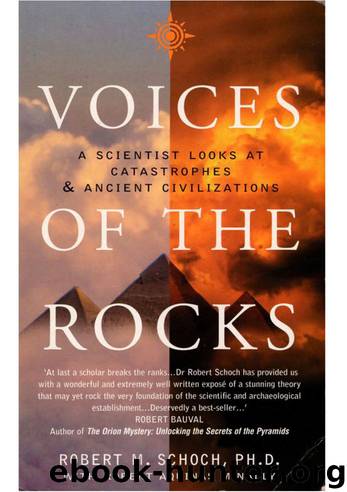
Author:Robert M. Schoch
Language: eng
Format: epub
The Moving Earth
But could it have been an earthquake? The eminent excavator C. F. A. Schaeffer first suggested that a devastating series of earthquakes was the Bronze Age culprit, and his idea has been championed by several archaeologists since then. Certainly, the idea bears looking at. The eastern Mediterranean is seismically active, and major earthquakes are known to have affected the area in both recent and ancient times. During the great batde of Joshua against Jericho, for example, which occurred about two hundred years after the end of the Bronze Age, it may well have been an earthquake that brought the walls tumbling down.
The problem with the earthquake explanation is that it doesn't fit the data well. As Robert Drews points out in The End of the Bronze Age, earthquakes often damaged ancient cities, but in the absence of other factors, like a simultaneous armed attack, they very rarely completely destroyed them. One of the few exceptions occurred in 373 B.C. when a devastating earthquake hit the Gulf of Corinth in Greece. The city of Bura was leveled, and the city of Helike sank under the waters of the widened gulf—an event that, as we saw in chapter 4, may have given Plato ideas about the end of Atlantis. Generally, however, when earthquakes struck ancient cities, the survivors would rebuild their homes rather than abandon them, as happened at the end of the Bronze Age. In some ancient cities, it seems, earthquakes became a regular part of life. Constantinople (formerly known as Byzantium, and now the modern Istanbul), for instance, apparently experienced a major earthquake on average once or twice a century in ancient and Byzantine times, and tremors much more often. Still, the city survived and flourished.
Furthermore, earthquakes in ancient times were not associated with devastating fires, like the blaze that turned San Francisco into a smoking ruin in 1906. The raging fires that often accompany modern earthquakes are due to broken gas pipes, snapped electrical cables, and so forth. Of course, ancient cities lacked gas and electricity. An overturned lamp might cause a small fire that could destroy a single building, but even that appears to have been an unusual occurrence. Most ancient cities were built principally of masonry, with the result that small, localized fires did not easily spread over great distances. A study of several hundred earthquakes in the eastern Mediterranean region between 600 B.C. and A.D. 600 showed that not a single one was responsible for a citywide fire. Yet it is this very sort of major conflagration, repeated again and again, that typifies the end of the Bronze Age.
Clearly earthquakes, like volcanoes, did not finish off Troy or any of the other great Bronze Age cities.
Download
This site does not store any files on its server. We only index and link to content provided by other sites. Please contact the content providers to delete copyright contents if any and email us, we'll remove relevant links or contents immediately.
Man-made Catastrophes and Risk Information Concealment by Dmitry Chernov & Didier Sornette(6019)
The Revenge of Geography: What the Map Tells Us About Coming Conflicts and the Battle Against Fate by Kaplan Robert D(4077)
Zero Waste Home by Bea Johnson(3839)
COSMOS by Carl Sagan(3625)
Good by S. Walden(3558)
In a Sunburned Country by Bill Bryson(3542)
The Fate of Rome: Climate, Disease, and the End of an Empire (The Princeton History of the Ancient World) by Kyle Harper(3067)
A Wilder Time by William E. Glassley(2863)
Camino Island by John Grisham(2798)
Organic Mushroom Farming and Mycoremediation by Tradd Cotter(2692)
The Ogre by Doug Scott(2683)
Human Dynamics Research in Smart and Connected Communities by Shih-Lung Shaw & Daniel Sui(2501)
Energy Myths and Realities by Vaclav Smil(2493)
The Traveler's Gift by Andy Andrews(2461)
9781803241661-PYTHON FOR ARCGIS PRO by Unknown(2372)
Inside the Middle East by Avi Melamed(2357)
Birds of New Guinea by Pratt Thane K.; Beehler Bruce M.; Anderton John C(2255)
A History of Warfare by John Keegan(2244)
And the Band Played On by Randy Shilts(2209)
